
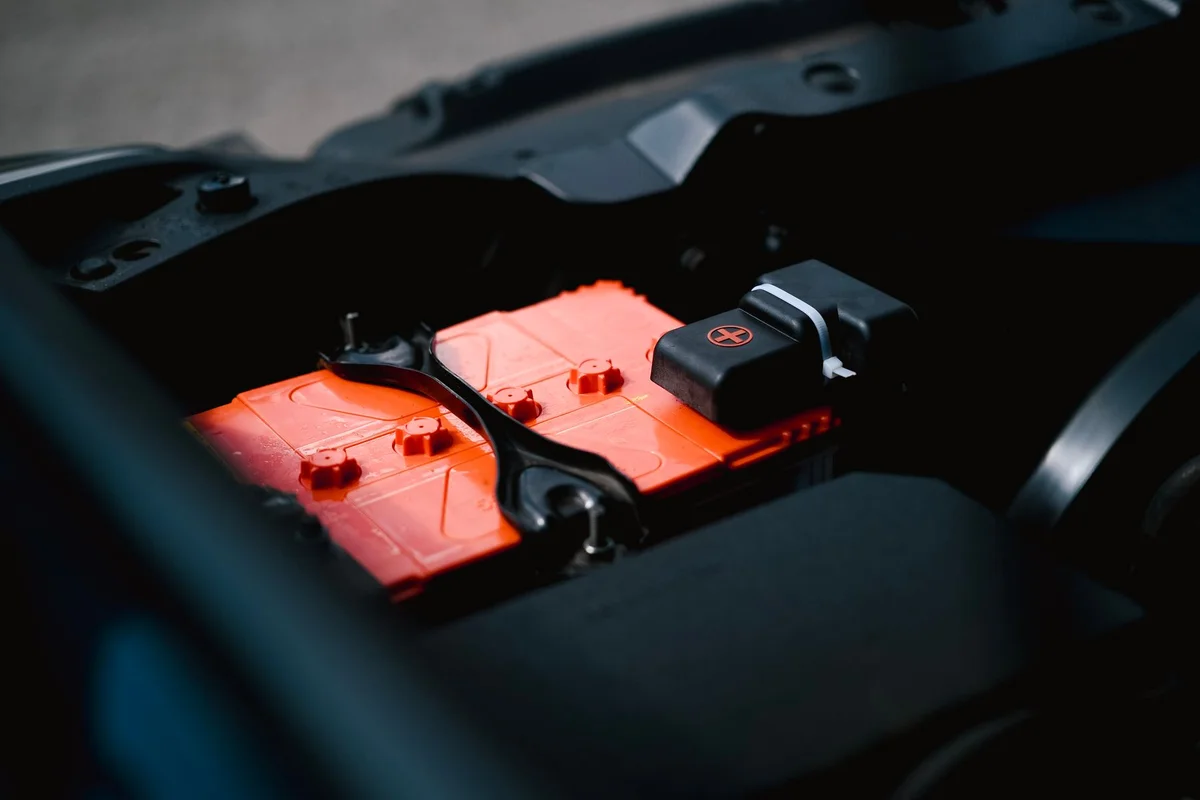
How to Replace a Car Battery
Quick Answer: Test the old battery first, then buy the correct group size with equal or higher cold cranking amps. Disconnect negative first, lift out the old battery, set the new one in, and connect positive first. The job takes about 30 minutes. A swollen, cracked, or leaking battery means stop and get help.
Safety First
A car battery holds sulfuric acid and gives off flammable hydrogen gas. Leaking fluid can burn skin and damage clothing, paint, and wiring, per AAA. Wear safety glasses and gloves and work in fresh air. Never smoke near a battery. If acid touches skin or eyes, wash with clean water and seek medical help. Take off rings and watches: a wrench touching both terminals can short.
Key rule: negative off FIRST and on LAST, as Bear Car Care states. Batteries weigh 30 to 50 pounds, per Bear Car Care: lift with your legs and do not tip the battery. Stop and get help if the case is swollen, cracked, or leaking, or if you smell rotten eggs.
This guide covers the 12 volt starter battery only. The high voltage traction battery in an electric car is a different part with orange cables: never touch it. Check the manual for the 12 volt battery location on hybrids and EVs.
How Long Does a Car Battery Last?
How long does a car battery last? For most drivers, 3 to 5 years. AAA gives that range: 5 years or longer in cooler northern climates, about 3 years in hot southern areas. Use 4 years as a planning number; test yearly from age 3, per AAA.
Consumer Reports, citing AAA data, puts the average at under 41 months in the hottest US regions, versus 58 months or more in the coldest. Heat does the damage and cold exposes it: AAA explains heat speeds up degradation. That is why November sees peak failures. MyApexDriver adds short trips under 15 minutes are hardest, and puts AGM life at 5 to 7 years in favorable conditions.
Signs of a Dying Car Battery
AAA lists 8 warning signs of a dying car battery:
| Sign | What It Means | How Urgent |
|---|---|---|
| Slow crank | Low starting power | Test this week |
| Rapid clicking, no crank | Too little power for starter | Test now |
| Headlights dim at idle | Weak battery at low revs | Test this week |
| Repeated jump starts | Not holding charge | Test or replace |
| Battery warning light on | Charging system fault | Test now |
| Swollen or leaking case | Internal damage | Stop, get help |
| Heavy terminal corrosion | Acid leakage | Clean, test soon |
| Rotten egg smell | Venting gas | Stop, get help |
The battery light usually means a charging system fault. See car dashboard symbols and meanings. One dead start after leaving the lights on does not prove a bad battery, per Bear Car Care: recharge, then test.
Battery or Something Else?
Narrow it down here, then confirm with a test.
| What Happens | Most Likely Cause | Next Step |
|---|---|---|
| Slow crank, starts with a jump | Weak battery | Test, replace if it fails |
| Rapid clicking, lights dim | Weak battery, bad connection | Clean terminals, test |
| One click or nothing, lights bright | Bad starter | See a mechanic |
| Dies while driving | Bad alternator | Test charging system |
| Battery light stays on | Charging system fault | Test now |
| New battery goes flat in days | Parasitic drain, bad alternator | Shop test for drain |
| Flat after sitting weeks | Weak battery, normal drain | Charge and test |
Low voltage can contribute to a check engine light, but is not the usual cause. Read what does check engine light mean and why is my check engine light on. Use our OBD-II code lookup tool to read stored codes.
Jump or Replace?
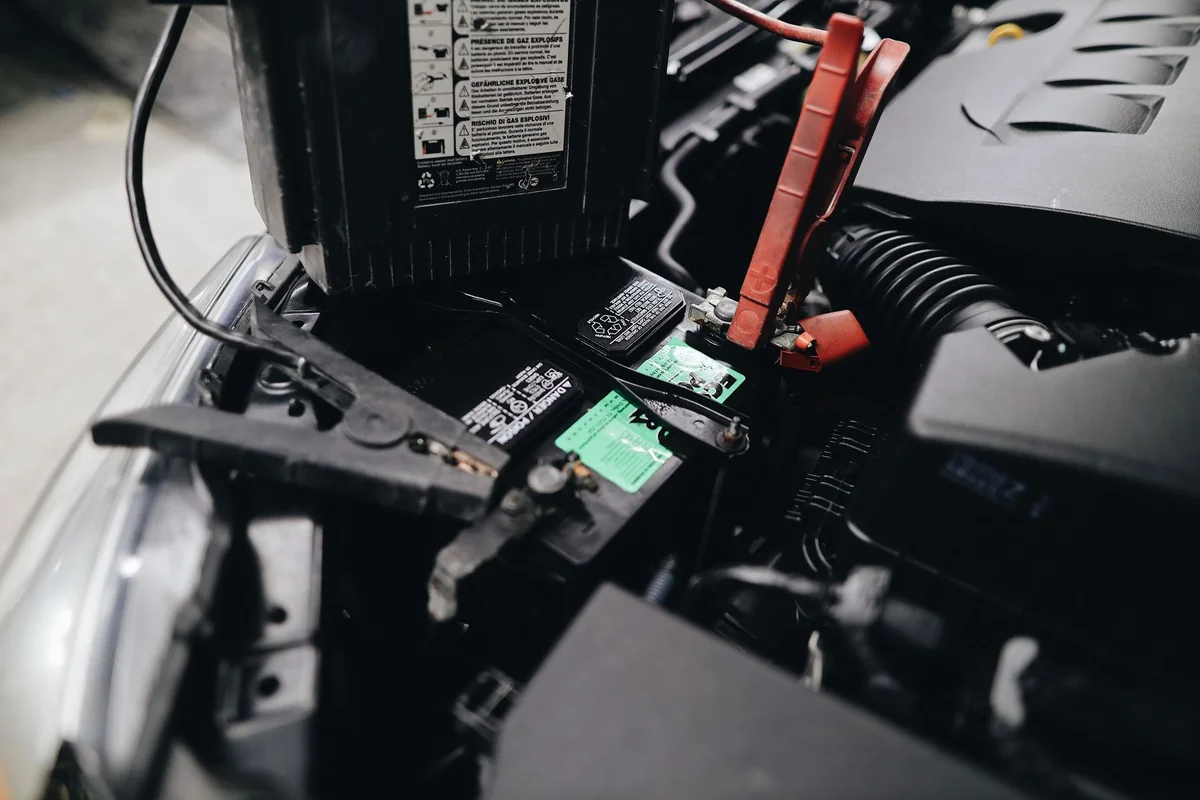
A jump is a rescue, not a fix. If the lights were left on, one jump plus a 20 to 30 minute drive may be enough. See how to use jumper cables. A second jump soon after means test or replace, per Bear Car Care. Never jump a swollen, cracked, leaking, or frozen battery.
Test Before You Replace
A voltage test shows charge level. A load test shows power under starting stress. Voltage alone does not prove health: Bear Car Care warns a battery can read 12.6 volts and still fail under load. Set a multimeter to DC volts.
- Turn everything off. Let the car sit a few hours if you can.
- Red probe to positive (+), black probe to negative (-).
- Read the resting voltage and compare it to the table. If low, recharge and retest.
- Start the engine and read again: voltage should rise.
| Test | Reading | What It Means |
|---|---|---|
| Resting, engine off | 12.6 volts or higher | Full charge, per the Alibaba guide |
| Resting, engine off | 12.4 to 12.6 volts | Partial charge, recharge and retest |
| Resting, engine off | Below 12.4 volts, or below 12.2 per Carista | Recharge, retest, load test |
| Running, engine on | About 13.7 to 14.7 volts | Healthy charging, per Carista |
| Load test, half CCA, 15 seconds | Stays above 9.6 volts | Passes under load, per the Alibaba guide |
| Load test, half CCA, 15 seconds | Drops below 9.6 volts | Fails under load, replace it |
Thresholds differ slightly (below 12.4 per the Alibaba guide, below 12.2 per Carista). Recharge first, confirm with a load test. AutoZone offers free testing at most locations.
Location and Terminals
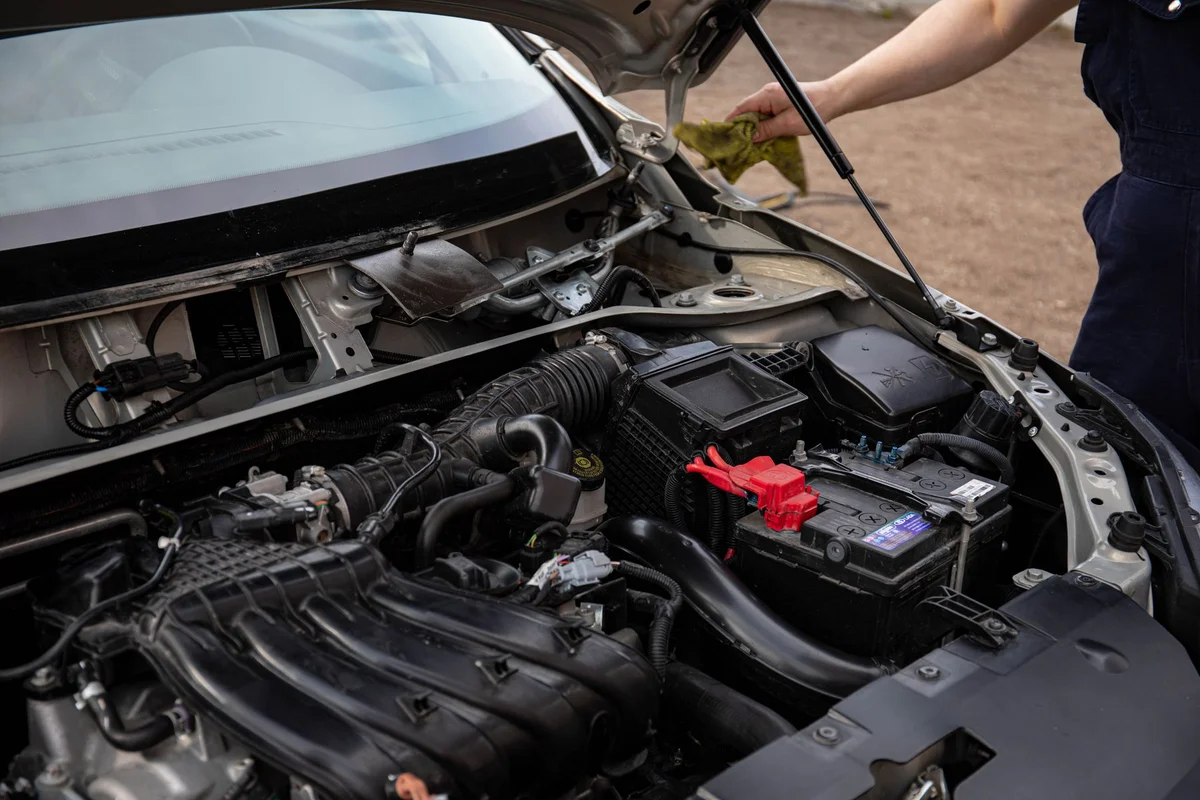
Most batteries sit in the engine bay. Some BMWs, Volvos, and Chrysler products put it in the trunk or under the rear seat, per Bear Car Care. AutoZone notes 2006 and newer Dodge Chargers carry it in the trunk.
| Location | Common On | What to Know |
|---|---|---|
| Engine bay | Most cars and trucks | Easiest access, about 30 minutes |
| Trunk, under a cover | Dodge Charger, many BMWs | Empty trunk, reconnect vent |
| Under a seat | Some BMW, Volvo, Chrysler, Dodge models | Tight access, check manual |
Inside-car batteries use a vent hose, which AutoZone notes must be reconnected.
| Terminal Type | How It Looks | Wrench Size |
|---|---|---|
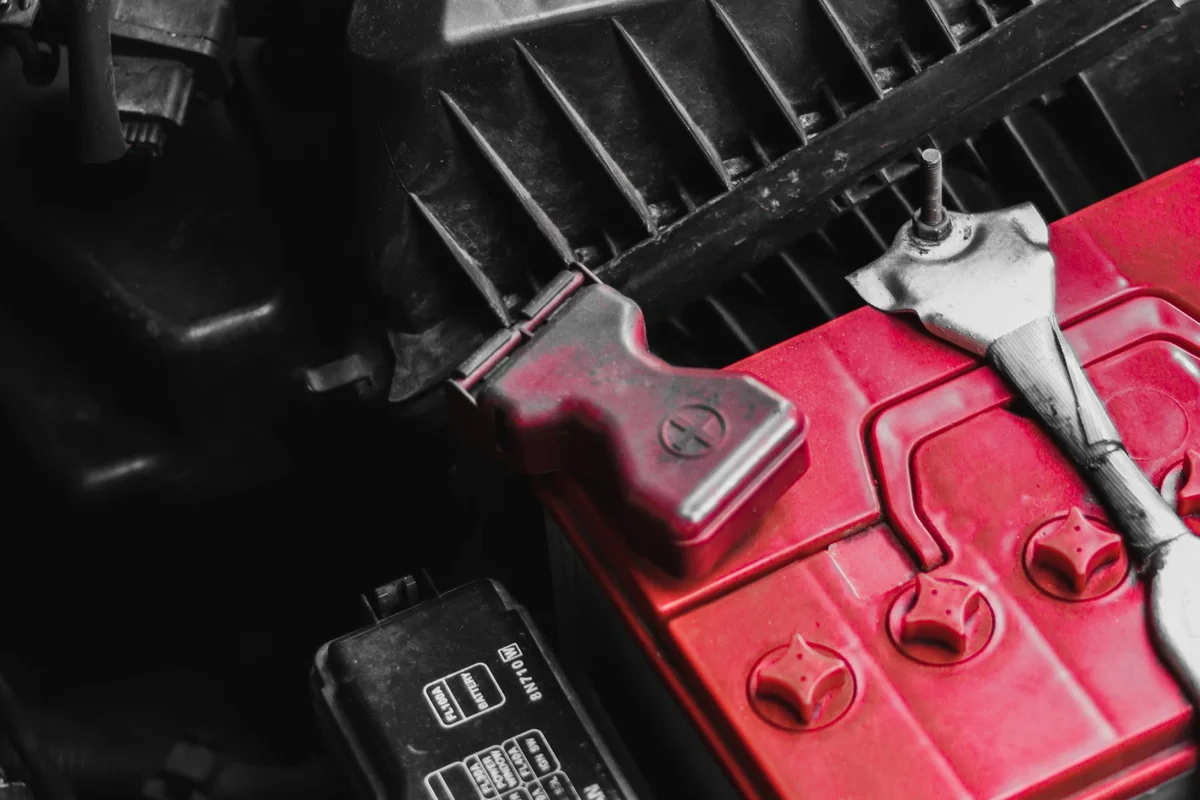
| Top-post | Posts on top | 10mm, per Bear Car Care |
| Side-post | Bolts thread into the side | 8mm socket, GM-style, per AutoZone |
If access is tight, let a shop do it.
Buying the Right Battery
The right battery depends on three specs, per Bear Car Care: group size, cold cranking amps, and reserve capacity. Find them in the manual or on the old battery label. Our VIN year decoder tool confirms your model year from your VIN.
Group size is the physical size and terminal position, such as Group 24, 35, or 48, sometimes with a European H size such as H6. Bear Car Care warns terminal position varies by group.
Cold cranking amps (CCA) measure power at 0 degrees Fahrenheit for 30 seconds, per Bear Car Care. Match or exceed your requirement, never go lower. Reserve capacity (RC) is backup power in minutes at a 25 amp draw if the alternator fails. Match your spec, or go higher.
| Type | How It Is Built | Best For | Cost and Life |
|---|---|---|---|
| Flooded lead-acid | Liquid acid | Cars without start-stop | Lowest cost |
| EFB (enhanced flooded battery) | Tougher flooded design | Basic start-stop cars | Mid cost |
| AGM (absorbent glass mat) | Glass mat, sealed | Start-stop, heavy electronics | Highest cost |
If your car came with AGM, replace it with AGM, per AAA and Bear Car Care.
Check freshness: AAA recommends asking for the manufacture date. Most batteries carry a date code, a letter for the month (A is January) plus a number for the year, so C6 means March 2026. Buy one less than 6 months old, per date-code guides. Keep your receipt.
Replacement Cost
Prices vary by size, type, and seller. Ranges checked November 13, 2026. Treat them as planning ranges, not quotes.
| Item | Typical Range | Source |
|---|---|---|
| Battery, all types | $100 to $550 | Bear Car Care FAQ |
| Battery, average in ratings | About $187, battery only | Consumer Reports, Oct 2025 |
| Flooded / AGM battery, retail | $100 to $200 / $200 to $350 | Retail pricing guides, 2026 |
| Shop labor | $20 to $90 | Bear Car Care FAQ |
| Parts store install with purchase | Free at most locations | AutoZone, March 2026 |
| Battery registration, where required | $50 to $150 | Repair guides, 2026 |
| Core charge, refunded on return | $5 to $20 | Battery retailer guides |
One model cost over $362, per Consumer Reports. The cheapest total is often a parts store install, free at most locations with purchase, per AutoZone. Do not buy on price alone.
What You Need
- 10mm wrench or socket: most top-post bolts, per Bear Car Care. Add an 8mm socket for GM side-post terminals.
- Socket set: hold-down bracket, often 10mm or 13mm.
- Safety glasses and gloves.
- Wire brush or terminal cleaner.
- Replacement battery: correct group size, CCA, and type, fresh date code.
The 10 Steps
About 30 minutes on most cars, per Bear Car Care. Work in a ventilated area, ignition off.
- Turn the car off. Ignition off, key out, engine cooled. Parking brake set, lights and accessories off.
- Find the battery. Find the positive (+) and negative (-) terminals.
- Disconnect the negative cable first. Loosen the negative (-) nut, lift the cable off, and tuck it away, then remove the positive (+) cable.
- Remove the hold-down bracket. Remove it and keep the hardware safe.
- Lift out the old battery. Lift straight up with your legs (30 to 50 pounds, per Bear Car Care), keep it level, and set it flat.
- Clean the tray and cable ends. Brush off corrosion, wipe the tray, and let it dry.
- Set the new battery in place. Terminals on the correct side. Reinstall the hold-down.
- Connect positive first, then negative. Tighten positive (+) then negative (-). Each clamp should grip clean metal and not wiggle.
- Protect the terminals and reconnect the vent hose. Apply spray or felt washers if you have them, and reconnect the vent hose if your car has one.
- Start the car and confirm. Idle a few minutes and check the battery light is off. Bear Car Care recommends a 20 minute drive.
Cable Order: Negative Off First, Positive On First
Registration and Memory Savers
Some newer cars need registration after a swap: it tells the computer a new battery is installed and resets the old charging history. VARTA describes the system: a sensor tracks the battery and adapts charging as it ages.
Bear Car Care notes these systems, common on newer European brands, require registration, and skipping it can shorten battery life significantly. BMW manuals recommend dealer registration, per The Daily Automotive. Sources disagree on overcharge versus undercharge, but agree it shortens battery life. Registration needs a scan tool and costs $50 to $150, per repair guides.
A memory saver plugs into the OBD-II port and keeps a low current flowing while the main battery is out, preserving keep-alive memory such as radio presets, per EngineerFix. EngineerFix warns the positive cable stays live, so if it touches metal it will short. Turn off all accessories, connect it before removing the negative cable, and keep the loose cable away from metal. It does not replace registration.
Reset Checklist
Bear Car Care notes many older vehicles need no resets; newer ones may need these set again.
- Clock: reset the time and date.
- Radio presets: re-enter saved stations. Some radios need a security code from the manual.
- Power windows: auto up and down may need a relearn: hold the switch up after the window closes, then down after it opens. Check your manual.
- Seat and mirror memory: re-save positions if fitted.
- Idle relearn: rough idle for a few drives is normal; a 20 minute drive usually settles it.
- Warning lights: brief lights that clear are normal. A light that stays on means get the charging system checked.
Do not disconnect the battery just to clear a check engine light: the fault stays and the light returns.
Disposal and Recycling
Never put a car battery in household trash. The US Environmental Protection Agency (EPA) says take lead-acid batteries to a retailer or household hazardous waste program, not trash or curbside bins. Batteries Plus notes it is illegal in almost every state: a standard battery holds about 18 pounds of lead. The EPA notes lead-acid batteries are about 99 percent recyclable.
Most parts stores accept old batteries free, per Bear Car Care. Take it to the store where you bought the new one, kept upright. Retailers add a $5 to $20 core charge on a new battery, per battery retailer guides, refunded when you return the old one. Keep your receipt.
When to Use a Shop
Let a professional handle it if the battery is swollen, cracked, leaking, frozen, or smells like rotten eggs; if your car needs registration and you have no scan tool; if access is tight; or if a new battery keeps going flat. A shop can also test the full charging system.
Frequently Asked Questions
How long does a car battery last?
Most last 3 to 5 years, per AAA: about 3 years in hot climates, 5 years or longer in cooler ones. Test yearly from age 3.
How much does it cost to replace a car battery?
Bear Car Care puts batteries at $100 to $550, plus $20 to $90 for shop labor. Consumer Reports reported an average battery-only price of about $187.
Can I replace a car battery myself?
Yes, on most cars with an engine bay battery. The job takes about 30 minutes, per Bear Car Care. Let a shop handle damaged batteries and cars needing registration.
Do I need to reset anything after replacing a car battery?
Often, yes. Reset the clock, radio presets, window auto positions, and seat memory. The engine needs a short drive to relearn idle.
What if my new battery dies too?
It usually means a failing alternator or a parasitic drain. Get the charging system tested.
How do I dispose of an old car battery?
Take it to an auto parts store or household hazardous waste program. The EPA says not to put lead-acid batteries in trash or curbside bins. Returning it earns back the $5 to $20 core charge.
The Bottom Line
Test yearly after age 3, and replace it when it fails a load test. Buy the right group size, CCA, and type, keep the cable order straight, and recycle the old battery. If anything looks risky, a shop can do the job in about 30 minutes. For the rescue step, read our guide on how to use jumper cables.
Reviewed by the AutoFixr Editorial Team. Every fact in this guide was checked against manufacturer service information and the named sources in this article, including AAA, Consumer Reports, and AutoZone. Battery sizes and prices vary by vehicle. Always follow your owner's manual.