
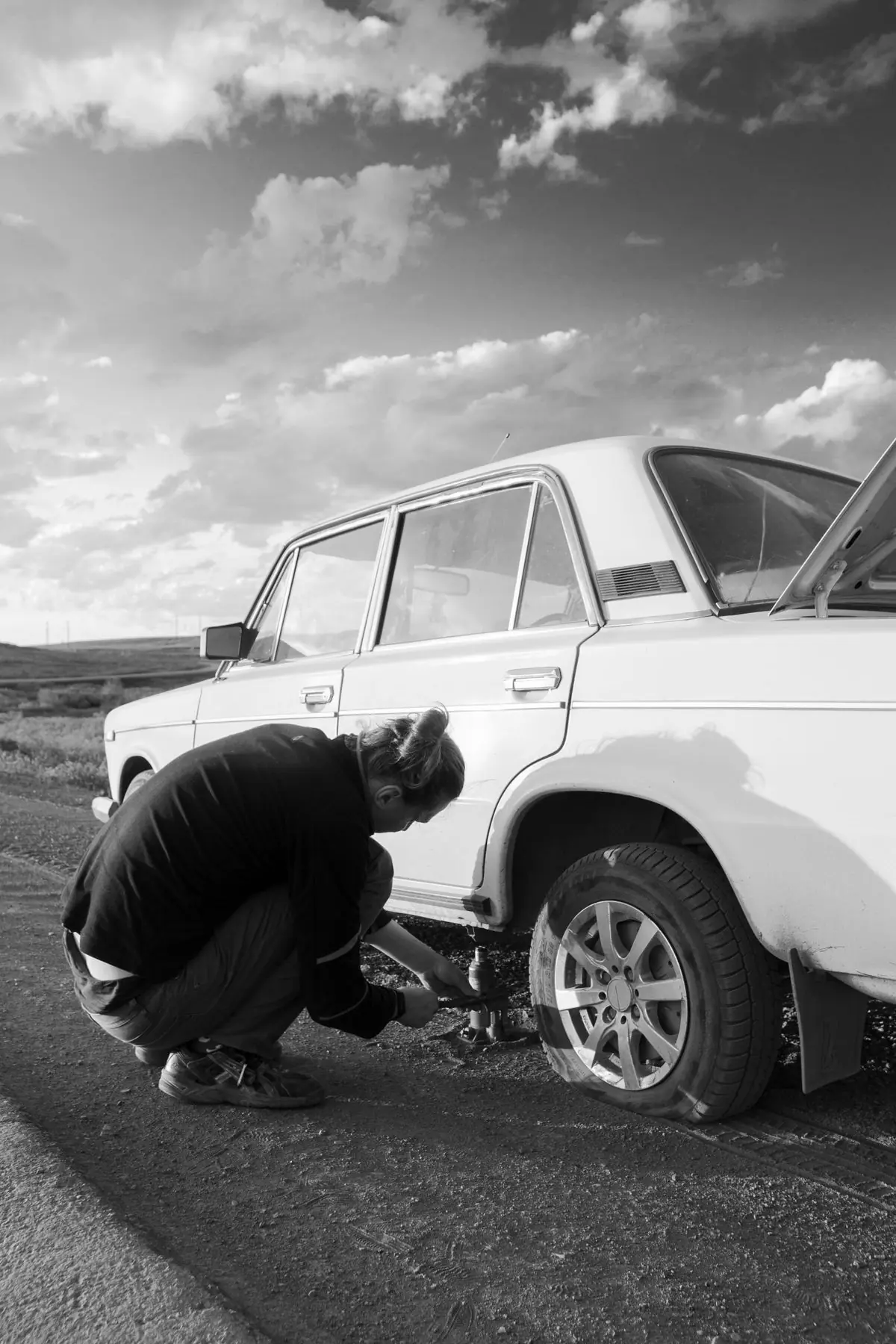
How to Replace a Tire
Quick Answer: To replace a tire, pull over somewhere safe, turn on your hazard lights, and set the parking brake. Loosen the lug nuts half a turn while the car is on the ground, jack up the car, remove the flat tire, put on the spare tire, and tighten the lug nuts in a star pattern. Drive to a tire shop right away, because a donut spare is only temporary.
What You Need: Tools and Supplies
To replace a tire, loosen the lug nuts half a turn while the car is on the ground, jack up the car, remove the flat tire, put on the spare, and tighten the lug nuts in a star pattern. The job takes 30 to 60 minutes for a first-timer. Most cars already carry the basic tools in the trunk, usually under the trunk floor mat or next to the spare tire, so check yours before you ever need it.
- Spare tire: donut or full-size, stored in the trunk or under the car.
- Jack: usually a scissor jack, stored with the spare.
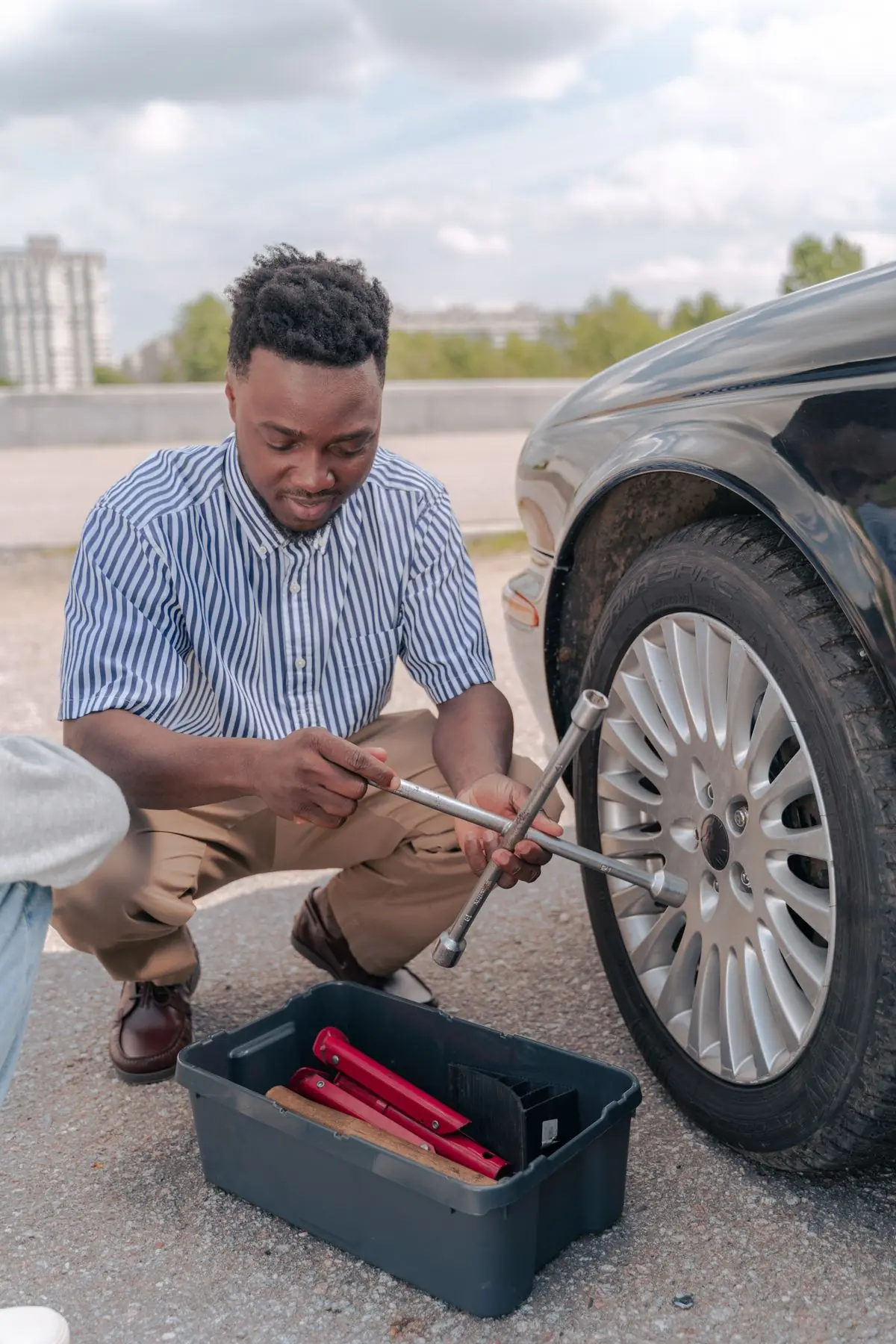
- Lug wrench: the cross-shaped or L-shaped wrench that fits your lug nuts.
- Owner's manual: it shows the jacking points and the lug nut torque for your car.
- Tire pressure gauge: to check the spare before you drive on it.
- Flashlight: if you are changing a tire at night.
- Gloves: to keep your hands clean and to protect them from hot parts.
- Wheel wedges or bricks: to stop the car from rolling. A large rock or a piece of wood works too.
- Reflective triangles or flares: to warn other drivers, especially at night or on a busy road.
- A small piece of wood, about 2 by 6 inches: useful if the ground is soft, to put under the jack.
A mechanic can change a tire in 15 to 30 minutes. A first-timer should allow 30 to 60 minutes. Take your time. Rushing is how mistakes happen.
Before You Start: Safety First
Tire-related problems contribute to more than 11,000 crashes every year in the United States, according to NHTSA. Most of those crashes happen because a driver kept driving on a damaged tire. When you get a flat, stop as soon as you can do so safely.
- Get off the road. Pull into a parking lot, a rest area, or a wide, flat shoulder. Never change a tire on a narrow shoulder next to fast traffic.
- Turn on your hazard lights. Do this as soon as you pull over.
- Park on flat, solid ground. Avoid slopes and soft dirt. The jack can sink or slip on soft ground.
- Set the parking brake. This stops the car from rolling.
- Put the car in Park for an automatic, or in first gear or reverse for a manual.
- Wedge the wheels. Put a wedge, brick, or rock behind the tire that is diagonally opposite the flat one. For example, if the front right tire is flat, wedge the rear left tire.
- Keep passengers out of the car. Have them stand well away from the road, behind a guardrail if there is one.
Safety note: Never put any part of your body under a car that is held up by a jack alone. A jack can slip or fail. Only reach under the car if it is also held up by a jack stand, which you will not have on the roadside. If you need to reach under the car, call for roadside help instead.
Lug Nut Torque: The Star Pattern
How to Replace a Tire: 12 Steps
Follow these steps in order. Do not skip ahead.
- Remove the hubcap or wheel cover. If your car has one, pry it off with the flat end of the lug wrench. Some hubcaps are held on by the lug nuts themselves, so they come off after step 3.
- Loosen the lug nuts half a turn. Use the lug wrench and turn each nut counterclockwise. Loosen them only half a turn. Do not remove them yet. The weight of the car on the ground stops the wheel from spinning while you loosen them. If a nut will not move, stand on the wrench arm carefully and use your body weight.
- Find the jacking point. Your owner's manual shows the exact spots. They are usually behind the front wheels or in front of the rear wheels, on a reinforced part of the frame. Using the wrong spot can damage the car or cause the jack to slip.
- Place the jack and raise the car. Put the jack under the jacking point. If the ground is soft, put a piece of wood under the jack first. Crank the jack until the flat tire is about 6 inches off the ground. The tire should spin freely.
- Remove the lug nuts. Unscrew them the rest of the way by hand. Put them somewhere safe, like in your pocket or in the hubcap, so they do not roll away.
- Remove the flat tire. Pull the tire straight toward you. It can be heavy, about 20 to 30 pounds. Lay it flat on the ground.
- Place the flat tire under the car. Slide it under the car near the jack. If the jack fails, the car will land on the tire instead of the ground. This is a simple safety trick that costs nothing.
- Mount the spare tire. Lift the spare onto the wheel studs. Line up the holes with the studs and push it on until it sits flat against the hub.
- Hand-tighten the lug nuts. Put the nuts on by hand and turn them clockwise until they are snug. Tighten them in a star pattern: top nut first, then the one opposite it, then the next, and so on. This keeps the wheel straight on the hub.
- Lower the car partway. Lower the jack until the spare tire just touches the ground and the car's weight is on it, but the car is not fully down yet.
- Tighten the lug nuts with the wrench. Use the star pattern again. Tighten each nut firmly, then go around a second time. The final torque should match your car's spec, which is in the table below. You cannot measure torque with a lug wrench, so tighten firmly and get the torque checked at a shop as soon as you can.
- Lower the car fully and remove the jack. Take the jack out, put the flat tire and tools back in the trunk, and check the spare tire pressure with your gauge.
You are done. Drive slowly and carefully to the nearest tire shop. Do not wait days. The spare is temporary.
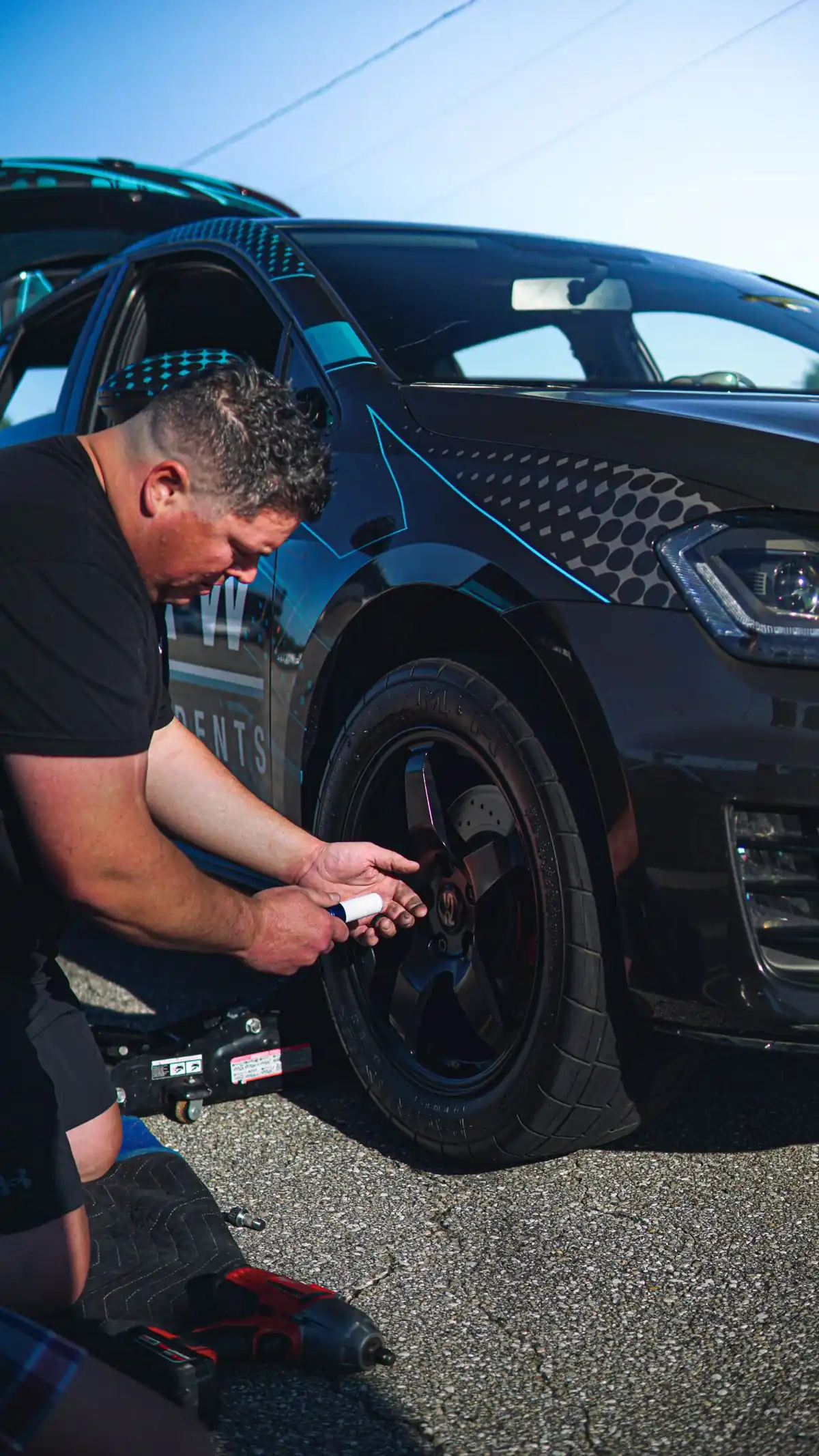
Lug Nut Torque Specs by Vehicle Type
Most guides skip this, but the right torque matters. Too loose, and the wheel can come off. Too tight, and you can strip the studs or warp the brake rotor. The table below gives typical ranges. Always check your owner's manual for the exact number for your car.
| Vehicle Type | Typical Lug Nut Torque |
|---|---|
| Small car or sedan | 80 to 100 ft-lbs |
| Midsize SUV or crossover | 90 to 110 ft-lbs |
| Large SUV or pickup truck | 100 to 140 ft-lbs |
| Always check | Your owner's manual has the exact spec |
If you have a torque wrench at home, use it to check the nuts after you drive about 50 miles. The nuts can settle a little after the first drive, and they may need a small extra turn.

Spare Tire Types and Limits
Not all spares are the same. Know which type you have before you drive on it.
| Spare Type | Speed Limit | Distance Limit | Notes |
|---|---|---|---|
| Donut (space-saver) spare | 50 mph max | About 50 to 70 miles | Temporary only, smaller than a normal tire |
| Full-size spare | Normal speed | No strict limit | Same size as your other tires |
| Run-flat tires | 50 mph max | About 50 miles | No spare needed, tire holds its shape |
A donut spare is smaller and lighter than a normal tire. It is made to get you to a shop, not to drive on for a week. Keep your speed under 50 mph and avoid sudden turns and hard braking. The car will handle differently with a donut on, especially in rain.
A donut spare is usually inflated to about 60 PSI, which is much higher than a normal tire. Check the pressure with a gauge before you drive. If it is low, use a portable air pump or stop at a gas station.
What to Do After You Fit the Spare
Fitting the spare is only the first half of the job. Do these things next.
- Check the spare tire pressure. A donut spare should be around 60 PSI. A full-size spare should match the pressure on the driver's door sticker. For more on pressures, see our guide on car dashboard symbols and meanings, which explains the tire pressure warning light.
- Drive to a tire shop right away. Have the flat tire repaired or replaced. If the tire is repairable, a patch costs about $20 to $40. A new tire costs $100 to $300 or more, depending on size and brand.
- Get the lug nut torque checked. A shop can check the torque with a torque wrench in a few minutes. Many shops do this free.
- Check the TPMS light. After you change a tire, the tire pressure warning light may stay on. This is normal. Drive for 10 to 20 minutes and the system often relearns the new tire. If the light stays on, the shop can reset it.
- Get an alignment check if the old tire wore unevenly. Uneven wear means the wheels were out of alignment. An alignment costs about $75 to $150. For more on when tires wear out, see our guide on how often should you change your tires.
- Replace the spare. Once the flat is fixed, put the repaired tire back as your spare so you are ready for next time.
Troubleshooting: Stuck Lug Nuts and Stuck Wheels
Sometimes things do not go smoothly. Here is what to do.
Stuck lug nut: Spray penetrating oil on the nut and wait 10 minutes. Then try again with the lug wrench. If you have a piece of pipe that fits over the wrench handle, use it for extra leverage. If the nut is rounded off and the wrench slips, stop. A shop can remove it with a special socket. Do not keep forcing it.
Stuck wheel: If the wheel will not come off the hub after you remove the nuts, it is rusted onto the hub. Kick the tire firmly at the top and bottom edges, or tap the back of the wheel with a rubber mallet. Do not hit the wheel with a metal hammer while it is on the car, because you can damage the brake parts behind it. Spray penetrating oil around the center of the hub and wait a few minutes, then try again.
Missing lug wrench: If the wrench is not in the trunk, check under the trunk floor and in the side compartments. If it is truly missing, call roadside assistance. Do not try to remove lug nuts with pliers or an adjustable wrench. They will round off the nuts.
No jack: If the jack is missing, call roadside assistance. Never use a bottle jack or a floor jack that is not rated for your car's weight.
What If You Have No Spare Tire?
More new cars come without a spare tire. They have run-flat tires, or a tire sealant kit, or nothing at all. Here is what to do in each case.
- Run-flat tires: You can drive about 50 miles at up to 50 mph on a flat run-flat tire. Drive to the nearest tire shop. Run-flat tires usually cannot be repaired after driving on them flat, so expect to buy a new tire.
- Tire sealant kit: The kit has a can of sealant and a small air pump. Connect the pump, inject the sealant, and inflate the tire. This is a temporary fix for a small puncture in the tread. It will not fix a sidewall cut or a large hole. Drive to a shop right away.
- No spare and no kit: Call roadside assistance or a tow truck. Do not drive on a flat tire. Driving on a flat rim will destroy the wheel and can damage the suspension.
If you are planning a long road trip and your car has no spare, consider buying a donut spare kit for your model. It costs about $150 to $300 and fits in the trunk.
Frequently Asked Questions
How long does it take to replace a tire?
A mechanic takes 15 to 30 minutes. A first-timer should allow 30 to 60 minutes. The first time is always slower. Practice in your driveway once, so you know where the tools and the jacking points are before you need them on the road.
Can I drive on a donut spare?
Yes, but only for a short distance and at low speed. Stay under 50 mph and drive no more than about 50 to 70 miles. Get the flat tire fixed as soon as possible. A donut is a temporary spare, not a real tire.
What is the star pattern for tightening lug nuts?
The star pattern means you tighten the nuts in a crisscross order, not in a circle. Tighten the top nut first, then the one directly opposite it, then the next one, and so on. This pulls the wheel evenly onto the hub and stops the brake rotor from warping.
What PSI should a spare tire be?
A donut spare is usually 60 PSI. A full-size spare should match the pressure on the driver's door sticker, which is usually 30 to 35 PSI for most cars. Always check the pressure with a gauge before you drive on a spare.
Can I replace a tire myself, or should I call a professional?
You can do it yourself if you have the tools, a safe place to work, and the car is on flat ground. Call roadside help if you are on a busy highway, on a steep slope, in bad weather, or if a lug nut is stuck and will not move.
How do I know if my flat tire can be repaired?
A puncture in the tread area that is 1/4 inch or smaller can usually be patched. A cut or hole in the sidewall cannot be repaired. The tire must be replaced. A tire shop can tell you in a few minutes.
Reviewed by the AutoFixr Editorial Team. Every fact in this guide was checked against manufacturer service information and NHTSA guidance. Torque specs are typical ranges. Always follow the exact spec in your owner's manual.