
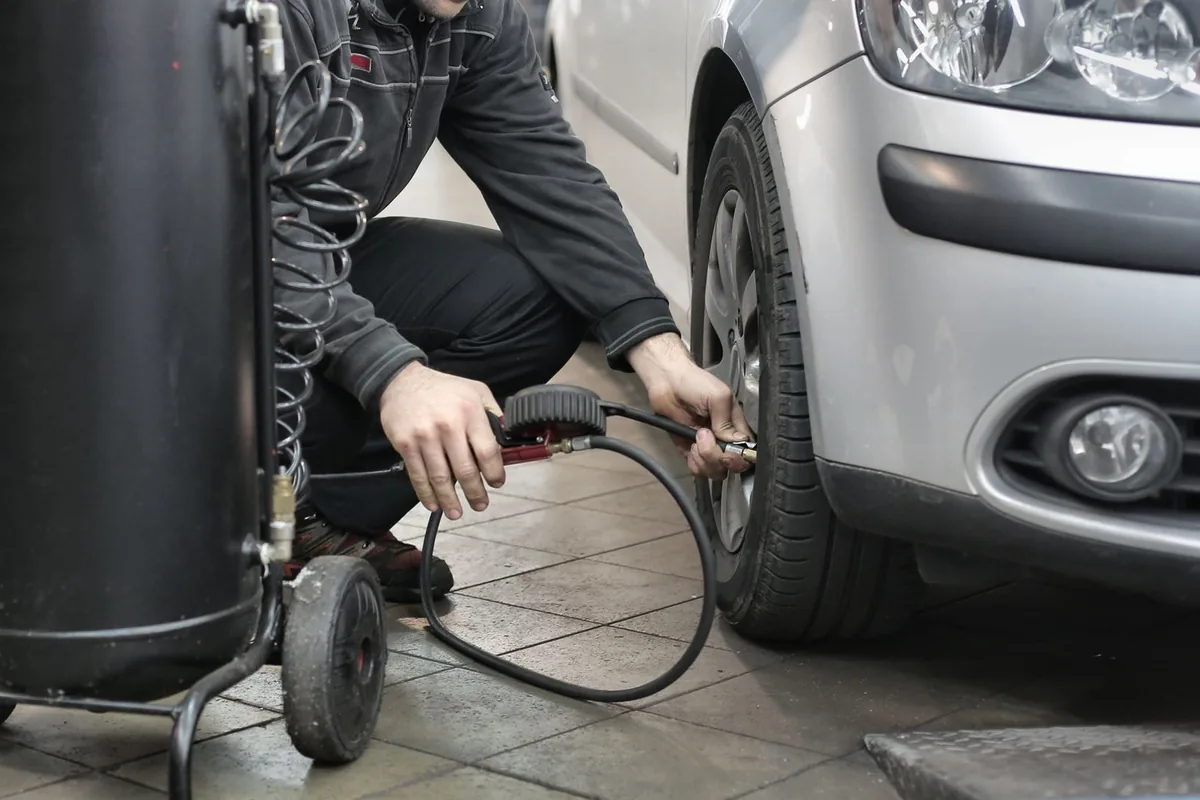
How to Check Tire Pressure
Quick Answer: Find the cold PSI on the sticker inside the driver door jamb. Remove the valve cap, press a gauge straight onto the valve stem, and read the number. Check the tires cold, before driving or after sitting for at least 3 hours. Add air if below the placard number. Check monthly. The TPMS light is a late warning, not a gauge.
Why It Matters
Low pressure is a safety problem. The National Highway Traffic Safety Administration (NHTSA) estimates about 11,000 tire-related crashes happen each year in the United States. Underinflation is a leading cause of tire failure.
Low pressure costs fuel too. FuelEconomy.gov, the joint site of the U.S. Department of Energy and the Environmental Protection Agency (EPA), says underinflated tires can lower gas mileage by about 0.2 percent for every 1 PSI drop in the average pressure of all four tires. Correct pressure can improve gas mileage by 0.6 percent on average, up to 3 percent. Use our MPG calculator and fuel cost calculator for your car. Tires lose 1 to 2 PSI per month.
What PSI Should My Tires Be?
The right PSI is the cold pressure printed on your car. Open the driver door and read the tire and loading information placard on the door frame. It lists cold pressure for front and rear tires, also found in the owner's manual.
Do not use the sidewall number. That is the maximum the tire can hold, often 44 or 51 PSI. The placard is set by the car maker for your car and wins over any generic table. Ranges below are typical only, reconciled from NeoTires, The Tire Deal, and Inflator.org. Check the placard tire size with our tire size calculator.
| Vehicle Type | Cold PSI | Notes |
|---|---|---|
| Compact and mid-size cars | 28 to 36 | Often same |
| SUVs and crossovers | 32 to 40 | Rear higher |
| Pickups, unloaded | 35 to 45 | Front and rear |
| Pickups, loaded rear | 40 to 50 | See below |
| Heavy-duty trucks | 50 to 80 | LT tires |
| Electric vehicles | 36 to 44 | Battery weight |
| Donut spare | 60 | Temporary |
| Light trailers | 50 to 65 | Trailer placard |
Temperature Effects
Check pressure cold: parked for at least 3 hours or driven less than 1 mile. After a highway drive, readings can be 3 to 6 PSI higher than cold (sources give 3 to 5 PSI and 4 to 6 PSI). Never let air out of a hot tire. It will be underinflated once it cools. Recheck cold the next morning.
NHTSA states tire pressure drops about 1 PSI for every 10 degrees Fahrenheit. That is why the TPMS light often appears on the first cold morning of fall.
| Temperature Change | Pressure Change | Example: 35 PSI Placard |
|---|---|---|
| 10F cooler | About 1 PSI lower | About 34 PSI |
| 50F cooler | About 5 PSI lower | About 30 PSI |
| After driving, hot | 3 to 6 PSI higher | About 38 to 41 PSI |
Tires set to 35 PSI at 75F fall to about 30 PSI at 25F. Add air until the cold reading matches the placard.
Gauges Compared
Buy one gauge of your own. Do not rely on a gas station pump gauge. Station gauges get dropped and weathered, and many read several PSI off.
| Gauge Type | Typical US Price | How It Reads | Best For |
|---|---|---|---|
| Stick or pencil | 3 to 13 dollars | Rod slides out, marked in PSI | Glove box backup |
| Dial | 10 to 25 dollars | Needle on a round dial | No battery needed |
| Digital | 7 to 30 dollars | Numbers on a screen | Easiest to read |
| Pump gauge | Included in pump cost | Dial or digital on pump | Topping up only |
Prices were checked on November 13, 2026 (US listings via AutoCostGuides and RevRated). A basic digital gauge for 10 to 15 dollars is the best buy. A dial gauge suits drivers who prefer no battery. A stick gauge is cheap, but hard to read in poor light. Avoid cap-style gauges. A portable 12 volt compressor typically costs 25 to 80 dollars (basic corded models) and lets you fill cold at home.
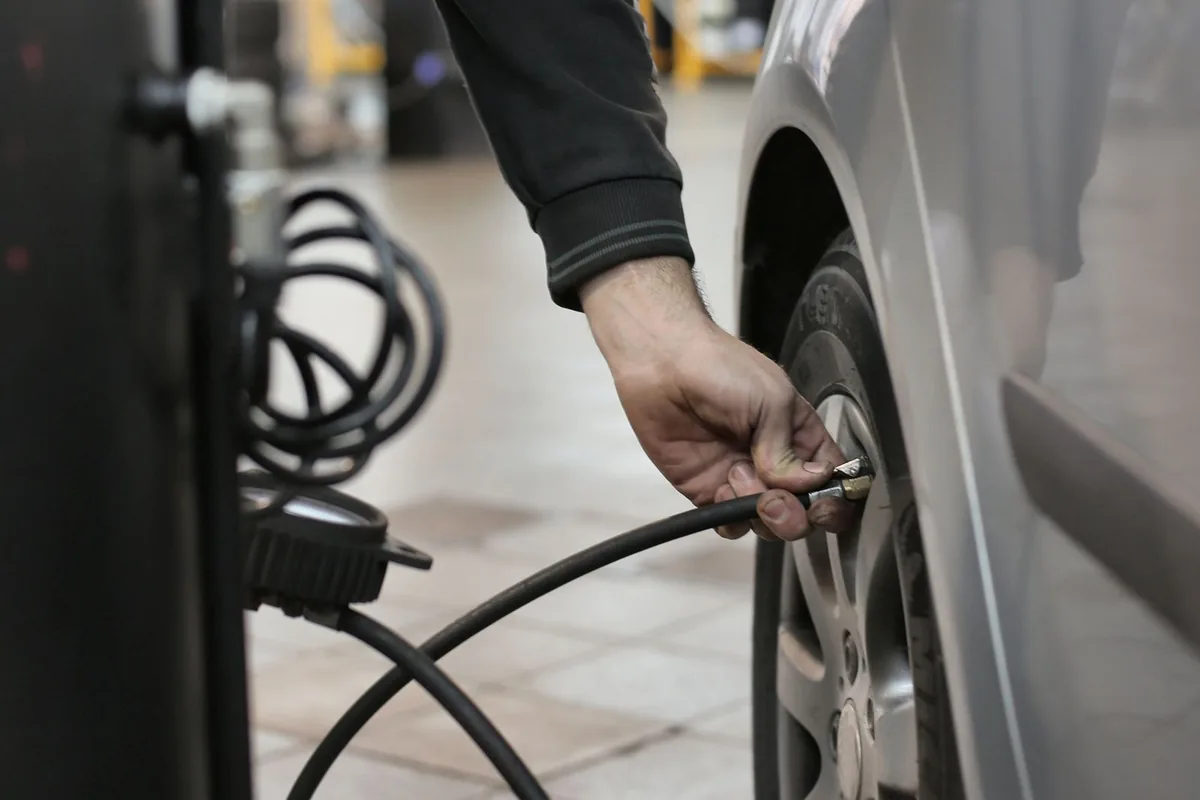
How to Check Tire Pressure With a Gauge
The job takes about five minutes.
- Find your target PSI. Read the placard on the driver door frame.
- Check the tires cold. Check before driving, or after sitting for at least 3 hours.
- Remove the valve cap. Unscrew the cap and put it in your pocket.
- Press the gauge straight onto the valve stem. Push firmly until the hissing stops. A long hiss means a poor seal. Reseat the gauge.
- Read the number. Compare it with the placard for that axle.
- Add air if low, or release air if high. Add air in short bursts, then recheck. To release air, press the valve pin briefly, then recheck.
- Replace the valve cap. Screw it on finger tight.
- Repeat for all four tires. See the slow-leak section if one tire is 5 PSI or more below the others.
Safety note: Park on flat ground, set the parking brake, and switch the engine off. Do not jack up the car. Never work under a car held up by a jack alone. If a tire looks flat or damaged, do not drive on it.
Gas Station Air Pump
Here is the full process.
- Know your target PSI before you leave home. Read the placard, bring your own gauge, and check each tire first.
- Find the air pump. It is usually at the edge of the forecourt or beside the car wash.
- Park so the hose reaches all four tires. Pull up with the pump near the middle of the car.
- Pay, or ask for free air. Paid pumps typically cost 75 cents to 2 dollars 50 cents for 3 to 5 minutes (2026 US listings). California requires free air for fuel customers (Business and Professions Code 13651). Ask the attendant to activate it. Connecticut requires free air for anyone. Wawa, Sheetz, and Costco offer free air (Family Handyman).
- Set the target on a digital pump, or use short bursts on a manual pump. On a digital pump, enter the placard PSI. On a manual pump, add air in 2 to 3 second bursts, then recheck.
- Recheck every tire with your own gauge before you drive away. Pump gauges are often inaccurate. Your gauge is the final word.
- Replace all four valve caps and check for a hissing valve. If a valve keeps hissing, press the pin briefly to reseat it.
After a drive, readings run high. Recheck cold the next morning.
TPMS Light and Reset
TPMS (Tire Pressure Monitoring System) has been required on new US passenger vehicles since 2008. It turns on a dashboard light, shaped like a flat tire with an exclamation mark, when pressure falls too low. See car dashboard symbols and meanings.
Direct TPMS uses a sensor inside each wheel. Indirect TPMS uses wheel speed sensors to spot a low tire rolling faster, only warns, and always needs a manual reset after adjusting pressures. Sensor batteries last about 5 to 10 years and cannot be replaced separately.
Steady light vs flashing light. A steady light means low pressure. Check all four tires and inflate to the placard number. A flashing light means a system fault, often a dead sensor battery. Adding air will not fix it. A light that appears in cold weather and clears after driving means pressure fell below the trigger. Inflate to the placard number cold.
The 25 percent trigger math. Under FMVSS 138, TPMS must warn at 25 percent or more below placard pressure. For a 35 PSI placard, the light comes on at about 26 PSI (35 minus 8.75). Tires can be 5 PSI low with no light at all.
How to reset TPMS after inflating. Methods vary by car. Check your owner's manual, TPMS section.
- Inflate all four tires to the placard pressure, cold. Include the spare if your car monitors it.
- Try the drive cycle first. Drive 10 to 20 minutes above 15 to 20 mph. Sensors only transmit while the wheels turn.
- If the light stays on, use the reset button or menu. Some cars have a reset button under the dashboard or in the glove box. Hold it, ignition on and engine off, until the light blinks three times, then drive. Others use a menu item: Calibrate, Initialize, or Store Pressures.
- If the car needs a tool relearn, visit a shop. Some GM, Ford, and other models need a TPMS tool held at each valve stem in a set order.
- If the light still flashes, get a scan. Shops often read sensors free.
Never reset the light to keep driving on a low tire. If it returns within days, you have a leak.
TPMS sensor replacement cost. Sources disagree sharply. AutoCostGuides: 30 to 80 dollars plus 20 to 40 dollars installation. MyApexDriver: 50 to 150 dollars plus programming. CarWhere (November 2026 chain prices): about 65 to 125 dollars per wheel. RepairPal: 240 to 299 dollars standalone. Kelley Blue Book: 314 to 368 dollars. Get an itemized quote.
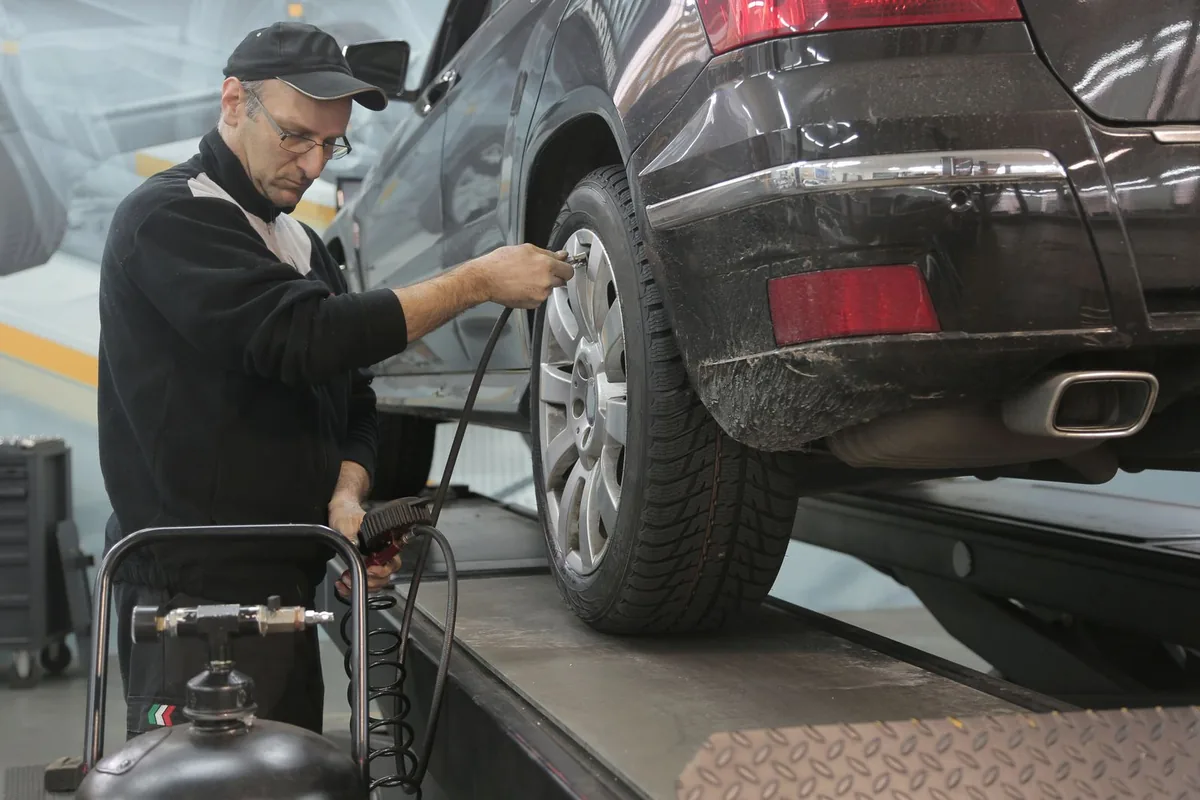
The Spare Tire
Spares lose air like road tires. A donut spare typically needs 60 PSI (Goodyear and the U.S. Tire Manufacturers Association). Check the exact number on the placard or spare. A full-size spare takes the placard pressure.
Reach it under the trunk floor cover or underbody carrier. Check it like a road tire. Add air before you need it. Do not drive faster than 50 mph on a donut. Most makers limit donut use to about 50 to 70 miles. For the full change procedure, read our guide on how to replace a tire. Replace a spare by 10 years old. Use our tire age checker to read the DOT date code.
Loaded and Towing
The placard number assumes a normal load. Heavy loads and towing put much more weight on the rear tires, which need more pressure to hold their shape. Underinflated rear tires can sway while towing.
Many trucks print two numbers: normal and full load. Check the placard and manual for a loaded figure. Tire makers publish load and inflation tables for axle weight.
Truck guidance often adds 5 to 8 PSI at the rear when hauling a heavy payload. Some towing guides use 5 PSI as a starting point, not a spec. Never exceed the sidewall maximum. After the trip, return to the normal placard number. Trailer tires often run at the sidewall maximum when loaded. Follow the trailer placard. Check trailer tires cold before every trip, including the spare.
Slow Leaks
One tire 5 PSI or more below the others, or needing air every few days, means a slow leak. Topping it up is not a fix.
- Compare all four readings. A single low tire points to that tire. All four equally low points to temperature or neglect.
- Look at the low tire closely. Check the tread for a nail or screw, the sidewall for cuts or bulges, and the valve stem and cap.
- Do a soap water check. Mix dish soap with water. Brush it over the tread, valve stem, and rim edge. Bubbles mark the leak.
- Check the valve stem and rim. A leaking valve core or cracked stem is common. A shop can replace a valve stem for 10 to 30 dollars. Rim corrosion on older alloy wheels can also leak, and a shop can clean and reseal the rim.
- Get a proper repair, not just a plug. A patch-plug repair typically costs 20 to 50 dollars in the US in 2026 (Fixxr and Jerry). Discount Tire repairs repairable flats free. The U.S. Tire Manufacturers Association limits repairs to tread punctures up to 1/4 inch. Sidewall or shoulder damage, a large puncture, or a tire driven flat must be replaced.
If the tire goes flat overnight or shows a bulge, do not drive on it. Fit the spare.
Wear Patterns
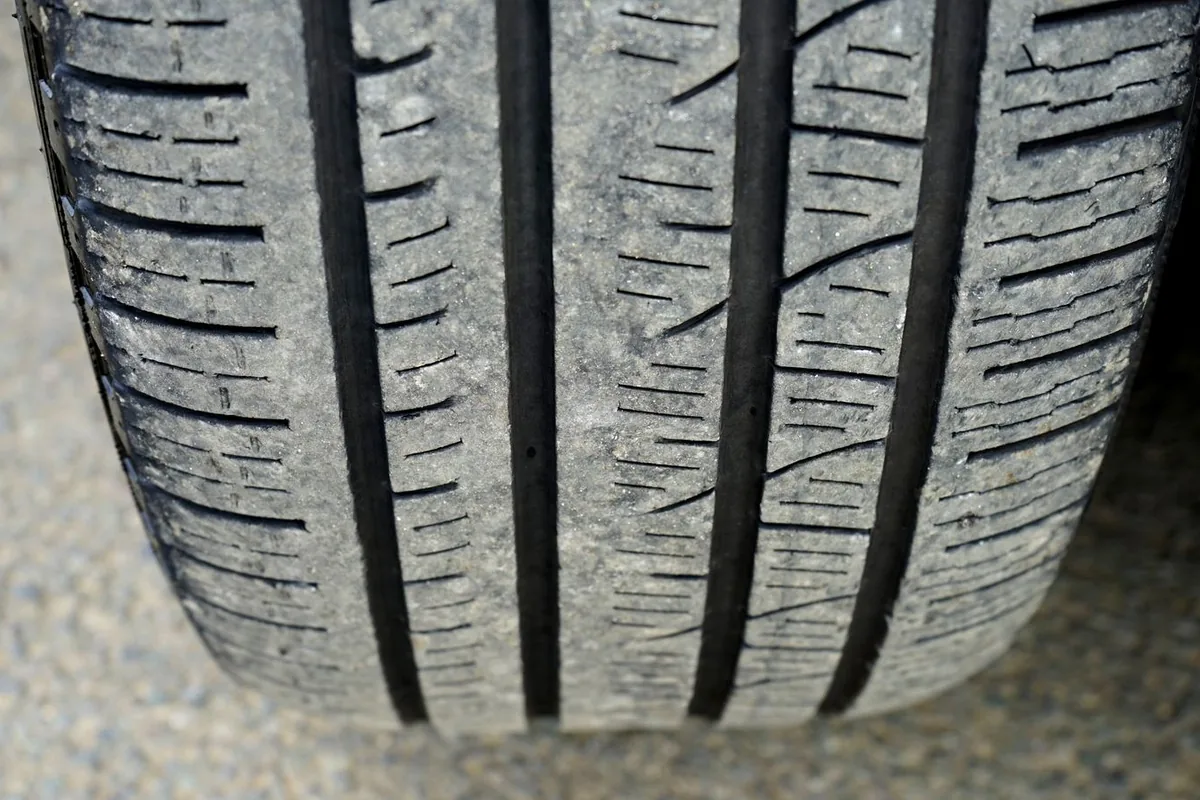
Center wear points to overinflation. Edge wear on both shoulders points to underinflation. One-sided wear points to an alignment problem. See a shop for an alignment check.
Tires are legally worn out at 2/32 inch. Plan replacement around 4/32 inch. See how often should you change your tires and how often should you rotate your tires.
Tire Wear Patterns: What Your Tread Is Telling You
Nitrogen vs Regular Air
Nitrogen costs 5 to 10 dollars per tire, free at some retailers such as Costco. The pitch promises better retention, fuel economy, and tire life. Evidence is more modest.
Regular air is already about 78 percent nitrogen. A nitrogen fill raises that to about 93 to 95 percent. Nitrogen passes through tire rubber a little more slowly than oxygen.
In a Consumer Reports 12-month test of 31 tire models, air-filled tires lost 3.5 PSI and nitrogen-filled tires lost 2.2 PSI, a difference of 1.3 PSI. Both kinds lost pressure, so monthly checks are still needed.
Fuel economy and tire life claims do not hold up once pressure is correct. NHTSA tests found the effect too small to change tire life or rolling resistance. Monthly checks with regular air give the same fuel economy. Nitrogen does not prevent punctures or leaks, and it still responds to temperature: about 1 PSI per 10 degrees Fahrenheit.
For normal drivers, nitrogen is fine if free, and not worth paying for if you check monthly. Topping up with regular air is safe. Never drive on a low tire because you cannot find nitrogen.
Frequently Asked Questions
How often should I check my tire pressure?
Check monthly and before long trips. Check again after a big temperature drop, a pothole hit, or 2 weeks parked.
Can I check tire pressure when the tires are hot?
Yes, but readings run 3 to 6 PSI high. Do not set the placard number on hot tires. Recheck cold the next morning.
Should I use the door jamb number or the tire sidewall number?
Use the door jamb placard number. The sidewall number is the maximum the tire can hold, not the driving pressure. The placard wins.
Why is the TPMS light still on after I filled my tires?
Recheck all four tires cold, including any monitored spare. Drive 10 to 20 minutes above 15 to 20 mph. If the light stays on, use the reset button or menu in your manual. Flashing at startup means a fault. Get a scan.
Is 40 PSI too high for my tires?
It depends on the placard. For a 32 PSI car, 40 PSI is too high. For a 40 PSI truck, it is correct. For a donut spare, it is too low. Most donuts need 60 PSI.
What should I do if one tire keeps going low?
Compare all four readings. Look for a nail, check the valve stem, and do a soap water check. Get a patch-plug repair, typically 20 to 50 dollars, for tread punctures up to 1/4 inch.
Reviewed by the AutoFixr Editorial Team. Every fact in this guide was checked against manufacturer service information and the named sources in this article, including NHTSA, FuelEconomy.gov, and Consumer Reports. Tire pressures and prices vary by vehicle. Always follow your owner's manual and door jamb placard.