
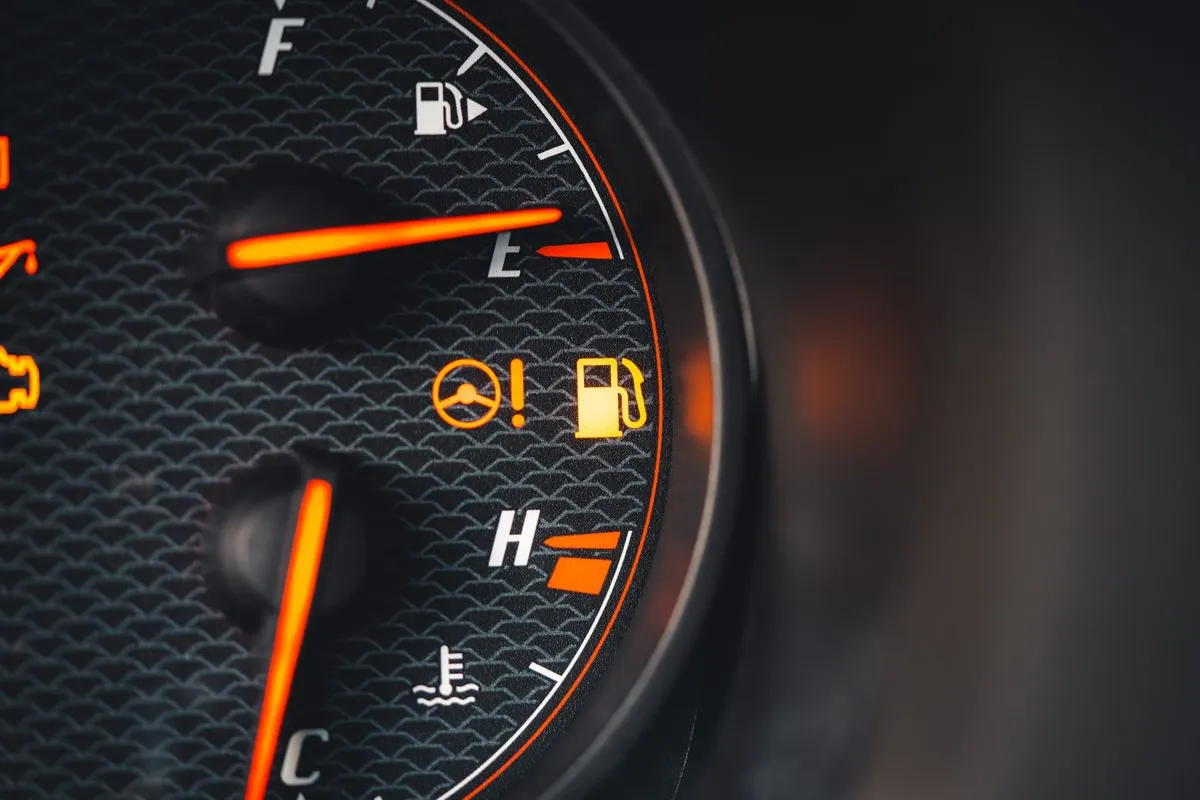
Tire Pressure Light on in Cold Weather
Quick Answer: The tire pressure light on in cold weather usually means cold air dropped your pressure below the warning threshold. Check all four tires cold and fill them to the door jamb placard pressure, not the sidewall number. A steady light means low pressure. A flashing light means a system fault.
Why the Light Comes On
The tire pressure light on in cold weather comes on because cold air makes the air inside your tires contract, so pressure falls with no leak. Tire pressure drops about 1 PSI for every 10 degrees Fahrenheit. If a tire was already a few PSI low, one cold night can push it below the warning threshold. Check all four tires cold and fill them to the door jamb placard pressure.
When a gas cools, its molecules slow down and push less hard on the tire walls, so the reading drops. When the tire warms up, the pressure comes back. That is why the light appears on the first cold morning of fall and can vanish by lunchtime.
The light is part of your Tire Pressure Monitoring System, or TPMS, required on passenger cars, light trucks, and vans since model year 2008. It is a late warning, not a gauge. NHTSA is clear: TPMS is not a substitute for regular tire maintenance. In a 2011 NHTSA survey of 6,103 vehicles, 71.1 percent had at least one tire 1 PSI low or more. The cold usually reveals a tire that was already low. See how to winterize your car.
How Much Tire Pressure Drops in Cold Weather
Tire pressure drops in cold weather by a predictable amount: about 1 PSI for every 10 degrees Fahrenheit. Continental, Michelin, and Bridgestone all give this figure. Goodyear puts the drop higher, at 1 to 2 PSI per 10 degrees. For a normal car tire at about 35 PSI, expect close to 1 PSI per 10 degrees.
This table shows one tire set to 35 PSI in a 70 degree garage, once it cools outside.
| Outside Temperature | Cold Pressure | Drop |
|---|---|---|
| 70 degrees F | 35.0 PSI | 0 PSI |
| 50 degrees F | 33.1 PSI | 1.9 PSI |
| 30 degrees F | 31.2 PSI | 3.8 PSI |
| 10 degrees F | 29.4 PSI | 5.6 PSI |
| Minus 10 degrees F | 27.5 PSI | 7.5 PSI |
A 40 degree overnight drop takes about 4 PSI out of the tire. Add seepage: tires lose 1 to 2 PSI per month through the rubber. A tire last checked in September can be several PSI low by November before the cold hits. Each new cold snap takes another PSI or two.
Tire Pressure vs Temperature
The TPMS Light Cold Weather Threshold
The TPMS light cold weather warning does not come on the moment a tire is a little low. Under the federal standard 49 CFR 571.138, the light must come on within 20 minutes after pressure falls to 25 percent below the recommended cold inflation pressure, or to a floor pressure in the standard's table, whichever is higher. A car may warn sooner, but it is not required to.
The light can stay dark until a quarter of your pressure is gone. Continental notes that tires can be 5 to 20 percent low without triggering the light. The gauge, not the light, catches that.
| Placard Pressure | Light Must Be On By | Air Lost |
|---|---|---|
| 30 PSI | 22.5 PSI | 7.5 PSI |
| 35 PSI | 26 PSI | 9 PSI |
| 40 PSI | 30 PSI | 10 PSI |
For a 35 PSI placard, the light must be on by about 26 PSI. A tire set correctly at 70 degrees would have to cool to about minus 23 degrees before cold alone pushed it there. But a tire that started at 30 PSI reaches 26 PSI at about 26 degrees. NHTSA links underinflated tires to approximately 11,000 crashes a year.
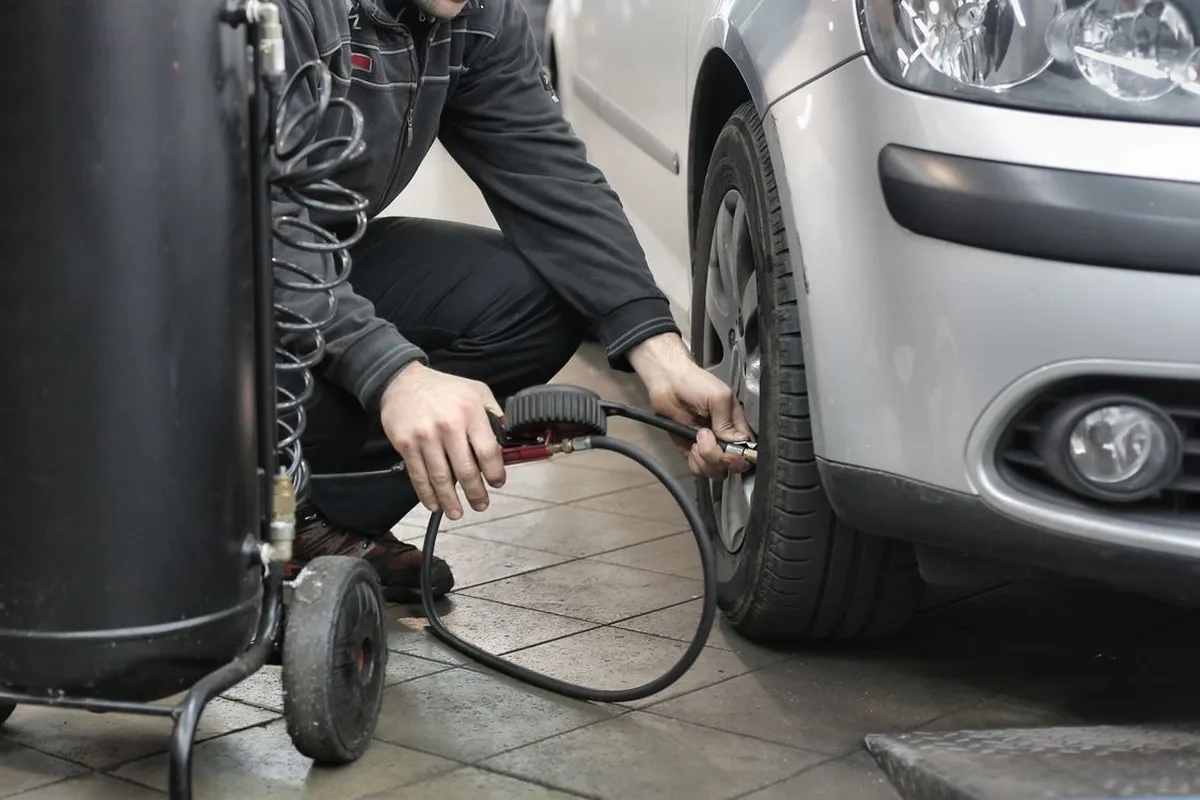
Steady Light vs Flashing Light
How the light behaves tells you what kind of problem you have. Watch it when you start the car. The light looks like a horseshoe with an exclamation mark, lit in yellow or amber. See our guide on car dashboard symbols and meanings for the full set of warnings.
| What the Light Does | What It Means | What to Do |
|---|---|---|
| Steady, stays on | A tire is about 25 percent low | Check all four tires, fill to the placard |
| Flashes 60 to 90 seconds, then steady | TPMS fault, system cannot watch tires | Check pressures by hand, get a shop scan |
| On in the morning, off after driving | Low when cold, rises as tires warm | Check and fill cold, do not ignore it |
The flashing pattern is set by the same federal standard. Under 49 CFR 571.138, section S4.4(c), the light must flash for 60 to 90 seconds when a malfunction is found, then stay lit until the fault is fixed. The most common cause is a dead sensor battery. Direct TPMS sensors have sealed batteries, and Continental puts battery life at 5 to 10 years. Weak batteries often fail first in cold weather.
Direct TPMS uses sensors inside each wheel and shows a reading per tire. Indirect TPMS uses wheel speed sensors, cannot say which tire is low, and needs calibration after pressure changes or rotations. Your owner's manual names your system.
The Light Went Off After Driving
The light going off after driving does not mean the pressure is fixed. Driving warms tires, and a warm tire reads 4 to 6 PSI higher than the same tire cold, according to Kia's owner's manual. A tire at 25 PSI cold can read 29 to 31 PSI after a drive, so the light goes out, then returns the next cold morning. Do not wait for warmer weather. Set the pressure cold, and the light stays off in the morning too.
Check Pressure With Cold Tires
Cold does not mean cold weather. It means the tires have not been warmed by driving. NHTSA defines a cold tire as one on a car that has not been driven for at least 3 hours. Some manuals add: driven less than 1 mile. Check before your first drive of the day, after the car sat overnight.
A warm tire reads 4 to 6 PSI higher than the same tire cold. Never let air out of a warm tire to match the placard. If you add air after driving, recheck cold the next morning.
Use the door jamb placard, not the sidewall number. The placard is the Tire and Loading Information label on the driver side door frame. NHTSA puts it directly: the correct pressure is what the vehicle manufacturer has listed, NOT what is listed on the tire itself. The sidewall number, often 44 or 51 PSI, is the maximum the tire can hold, not a target. Do not add extra air above the placard for winter. The placard number is already a cold pressure.
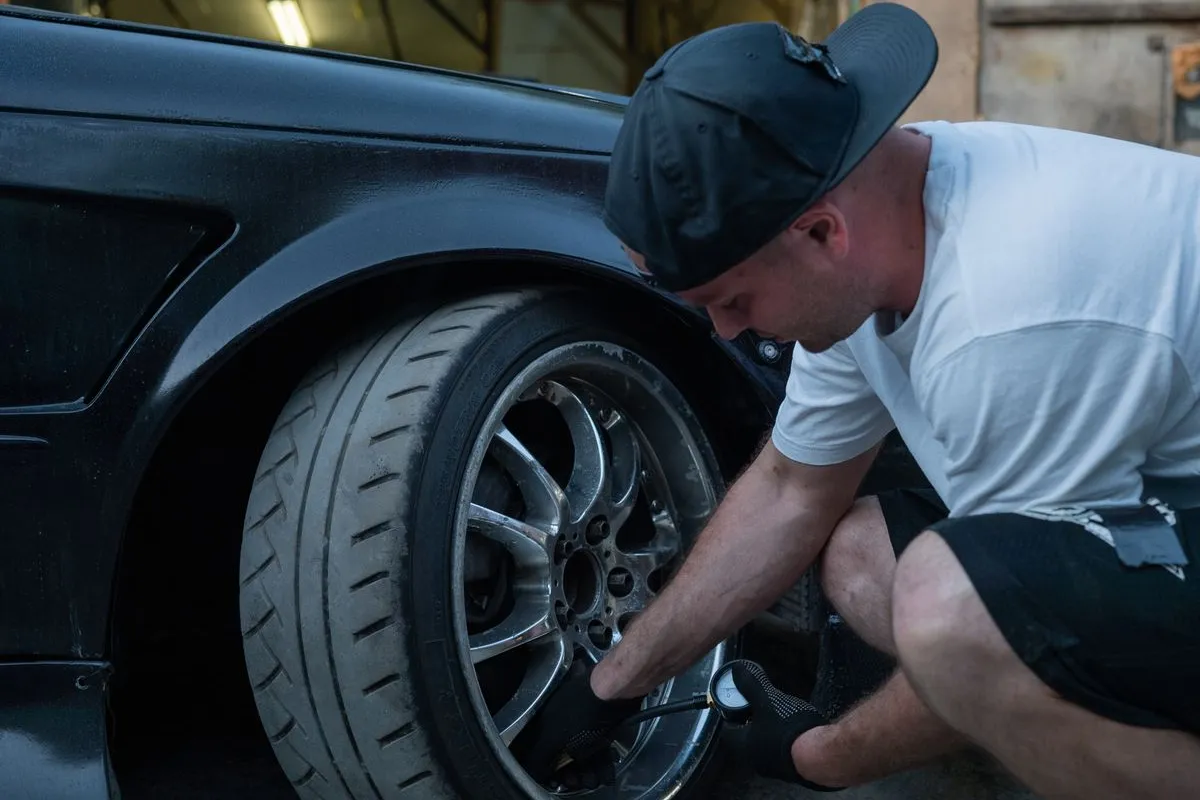
Check and Top Up the Pressure
Follow these steps in order. The job takes about five minutes. For the full gauge guide, see our guide on how to check tire pressure.
- Read the placard before you touch a tire. Open the driver door and find the Tire and Loading Information label on the door frame. Write down the cold pressure for the front and rear tires. Do not use the maximum pressure molded on the tire sidewall.
- Check the tires cold. Check before your first drive of the day, after the car has sat for at least 3 hours. A reading after driving runs high and hides a low tire.
- Measure all four tires with a gauge. Remove each valve cap, press the gauge straight onto the valve stem, and read the number. Write down all four readings before you add any air.
- Add air in short bursts to the placard pressure. Fill each low tire a little at a time and recheck with your gauge. If you go over, press the small pin in the center of the valve to let a little air out.
- Replace the valve caps and check the spare. Screw every cap back on finger tight. If your car monitors the spare, check it too.
- Drive 10 to 30 minutes so the light can clear. Most systems need a drive to read the corrected pressures. If your car needs a reset button, menu step, or calibration, follow your owner's manual.
- Recheck cold the next morning. Cold readings are the true readings. If one tire lost much more air than the others overnight, it may have a slow leak.
Write down all four readings before you add air. If all four dropped by about the same amount, cold and seepage are the cause. If one tire is well below the rest, it needs a closer look. Trust your own gauge, since gas station pump gauges are often several PSI off.
Safety note: Park on flat ground, set the parking brake, and switch the engine off. If a tire looks flat, bulged, or damaged, do not drive on it. Fit the spare or call for help.
When the Light Means a Real Leak
Cold weather lowers all four tires by roughly the same amount. A leak lowers one tire much more than the rest. If three tires read 31 PSI and one reads 24 PSI, the cold is not the cause. A tire that keeps needing air every few days has a physical problem.
- A puncture: a nail or screw in the tread can leak slowly for weeks.
- Valve stem trouble: rubber stems crack with age, and a loose valve core can seep air.
- Bead leaks: corrosion where the tire seals against the wheel, worse on older aluminum wheels exposed to road salt.
- Wheel damage: a hard pothole hit can bend a rim just enough to break the seal.
For a quick home test, mix dish soap and water in a spray bottle. Spray the tread, the valve stem, and the edge where the tire meets the wheel. Growing bubbles mark the leak. If the test finds a leak, get the tire inspected. Do not keep topping up a leaking tire for weeks. For the spare tire procedure, see our guide on how to replace a tire. If the light appeared after a rotation, allow 10 to 50 miles to relearn. See how often should you rotate your tires.
TPMS Repair Costs
Adding air costs nothing, or a few coins at a pump, and it fixes most cold weather lights. Costs appear only when a sensor has failed or a tire must be repaired. Figures below are November 2026 estimates. Get an itemized quote first.
Estimates disagree because they include different work. A sensor fitted during a tire change costs far less than a standalone visit with removal, refitting, balancing, and programming charged to one job.
| Job | Estimated Cost | Notes |
|---|---|---|
| TPMS diagnosis and reset | 50 to 150 dollars | Continental estimate |
| One sensor, including installation | 50 to 150 dollars | Continental, parts and labor |
| One sensor, standalone visit | 240 to 368 dollars | RepairPal and Kelley Blue Book averages |
| One sensor with a tire change | 60 to 150 dollars per wheel | Wheel already off the car |
| All four sensors | 200 to 600 dollars | Continental, sensors age together |
Sensor replacement is not a practical do-it-yourself job. The tire must come off the wheel, the sensor must be fitted and programmed, and the tire must be remounted and balanced. Many shops scan each wheel with a TPMS tool for free. Ask for the scan first, and ask whether the quote includes programming and relearn.
Keep the Light Off All Winter
NHTSA recommends checking tire pressure at least once a month, including the spare, when the tires are cold. Continental recommends every two weeks through winter. Monthly is the minimum. Check after any big temperature swing, and look again in spring, when warmer weather pushes pressure back up.
Keep a simple record: the date and all four readings each time you check. The record shows which tire loses more than the others, which is how a slow leak reveals itself. NHTSA says tires worn to 2/32 inch must be replaced. Use our tire age checker to read the date code, and see how often should you change your tires.
Nitrogen does not stop winter pressure drops. It loses pressure a little more slowly, but it still contracts in the cold just like regular air. Regular air is fine. See how to winterize your car for the full winter routine.
When to See a Shop
See a shop promptly if any of these apply:
- The light flashes, then stays steady. That is a system fault, often a dead sensor battery.
- The light stays on after correct inflation and a reset. The system needs diagnosis.
- One tire keeps losing air. A tire that needs air every few days has a leak.
- A tire looks flat, bulged, cut, or damaged. Do not drive on it.
- The car pulls, vibrates, or thumps. Stop driving.
Tell the shop exactly what the light did: steady or flashing, whether it went off after driving, and whether one tire kept losing air. Ask for a free TPMS scan and an itemized quote. While the system is faulty, check pressures by hand every two weeks.
Safety note: If a tire looks visibly flat or the car handles strangely, stop in a safe place right away. Driving on a flat tire destroys the tire quickly and can damage the wheel. Fit the spare, or call roadside assistance.
Frequently Asked Questions
Why does my tire pressure light come on in cold weather?
Cold air makes the air inside your tires contract, so tire pressure drops about 1 PSI for every 10 degrees Fahrenheit. If a tire was already a few PSI low, a cold night can push it below the TPMS warning threshold. Check all four tires cold and fill them to the door jamb placard pressure.
Will the TPMS light turn off on its own when the weather warms up?
It often does, because driving and warmer air raise the pressure again. That does not mean the tires are correctly inflated. Check the pressure cold and fill to the placard number, or the light will come back on the next cold morning.
Is it safe to drive with the tire pressure light on in cold weather?
A short, slow drive to the nearest air pump is usually fine if no tire looks flat and the car handles normally. Do not drive far, fast, or for days with the light on. If a tire looks flat, sounds odd, or the car pulls to one side, stop in a safe place and fit the spare or call for help.
Should I add extra air above the placard pressure in winter?
No. Fill to the placard pressure measured with the tires cold. The placard number is already a cold pressure, so it accounts for cold weather. Extra air only overinflates the tires when the weather warms up again.
What does a flashing TPMS light mean in cold weather?
A light that flashes for 60 to 90 seconds after you start the car and then stays on steady means the TPMS itself has a fault, often a dead sensor battery. Adding air will not fix it. Check the pressures with a gauge, then have the system scanned at a shop.
Why is my tire pressure light still on after I added air?
Recheck all four tires cold, including a monitored spare, and make sure each one matches the placard. Then drive 10 to 30 minutes so the system can relearn. Some cars need a reset button or menu step, and indirect TPMS needs calibration. If the light still stays on or flashes, get the system checked.
Reviewed by the AutoFixr Editorial Team. Every fact in this guide was checked against the sources named in the text, including 49 CFR 571.138, NHTSA, FuelEconomy.gov, and Continental. Always follow your owner's manual.